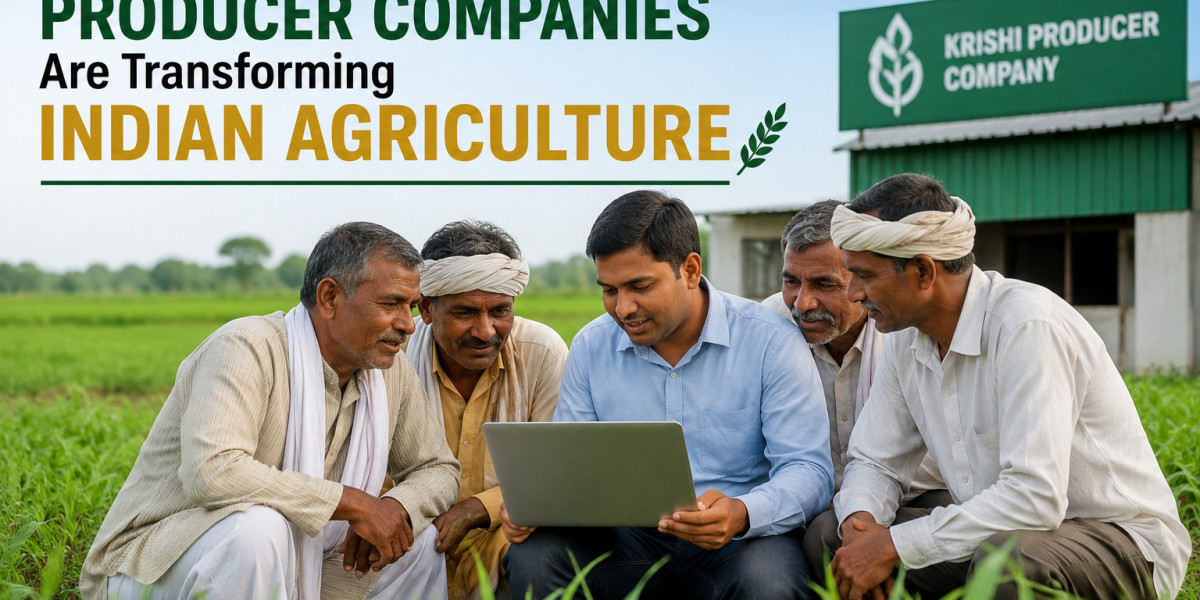

Indian agriculture feeds over a billion people, yet for decades, the individual farmer has remained one of the most economically vulnerable members of that system. Fragmented landholdings, exploitative middlemen, limited access to credit, and poor market linkages have kept rural incomes stubbornly low. Enter the Producer Company a legally recognized corporate structure that is quietly rewriting the rules of Indian farming.
If you're a farmer, agri-entrepreneur, or rural development professional wondering what a Producer Company is, how it differs from a cooperative, and how to go about company registration in India for one, this guide is for you.
What Is a Producer Company?
A Producer Company is a hybrid business entity that blends the democratic ethos of a cooperative society with the operational efficiency and legal clarity of a private limited company. It was introduced through the Companies (Amendment) Act, 2002, which inserted Sections 581A to 581ZT into the Companies Act, 1956. Today, it is governed under the Companies Act, 2013.
At its core, a Producer Company can only be formed by:
Primary producers — individuals engaged in any primary produce activity (farming, horticulture, animal husbandry, fisheries, handloom weaving, etc.)
Producer institutions — organisations whose members are primarily engaged in such activities
Why Producer Companies Are Changing the Game
1. Giving Farmers a Seat at the Table
Before Producer Companies, farmers sold their produce to whoever showed up at the farm gate , typically a commission agent or mandi trader who held all the pricing power. A Producer Company flips this dynamic. When farmers are the shareholders, they collectively decide where to sell, at what price, and through which channels.
This isn't theoretical. AMUL, while technically a cooperative federation, pioneered the model that Producer Companies are now scaling across grains, vegetables, pulses, and spices. Thousands of Farmer Producer Organisations (FPOs) registered as Producer Companies have negotiated directly with retailers, exporters, and even e-commerce platforms, cutting out three to four layers of intermediaries.
2. Access to Institutional Finance
One of the biggest constraints in Indian agriculture is access to formal credit. Individual smallholders are often deemed unbankable. A registered Producer Company, however, is a legal corporate entity with audited books, a board of directors, and a PAN, all of which make it eligible for:
NABARD equity grants under the FPO promotion scheme
Credit guarantee cover through SFAC (Small Farmers' Agribusiness Consortium)
Priority sector lending from commercial banks and RRBs
Working capital loans against hypothecation of produce
The Government of India's flagship scheme to promote 10,000 FPOs (most registered as Producer Companies) allocates equity grants of up to ₹18 lakh per FPO over three years, with matching grants contingent on mobilising member equity.
3. Technology Adoption at Scale
Individual farmers rarely have the capital to invest in precision irrigation, soil-testing labs, cold-chain infrastructure, or drone-based pest management. A Producer Company can pool resources and make these investments collectively, and many do.
In Madhya Pradesh, Producer Companies dealing in soybean have installed bulk procurement centers with electronic weighbridges and moisture meters, ensuring farmers receive fair price based on quality rather than arbitrary grading by traders. In Tamil Nadu, vegetable producer companies have partnered with agri-tech startups to deliver real-time mandi price alerts directly to members' phones.
4. Value Addition and Brand Building
Perhaps the most transformational opportunity a Producer Company offers is the ability to process and brand produce before it reaches the consumer. Moving up the value chain, from selling raw tomatoes to selling branded sun-dried tomatoes or ketchup, dramatically improves margins.
Several Producer Companies in Maharashtra and Karnataka have successfully launched their own packaged goods brands, registered GI (Geographical Indication) tags, and sold produce directly to modern trade retailers and Quick Commerce platforms. This would have been impossible for individual farmers acting alone.
Producer Company vs. Cooperative Society: Why the Corporate Structure Wins
Many farmers ask: "We already have a cooperative. Why register a Producer Company?" The answer lies in governance, accountability, and operational agility.
Feature | Cooperative Society | Producer Company |
Governing Law | State Cooperative Acts (varies by state) | Companies Act, 2013 (uniform, central) |
Regulator | State Registrar of Cooperatives | Registrar of Companies (MCA) |
Board Accountability | Weaker; political interference common | Stricter; directors have fiduciary duties |
Auditing | Often lax | Mandatory statutory audit |
Profit Distribution | Limited dividend scope | Dividends permitted up to 25% |
Equity Fundraising | Very limited | Can induct investor equity (with limits) |
Ease of Operations | Bureaucratic | More flexible and professional |
Cooperatives carry a heavy legacy of political capture and poor governance in many states. Producer Companies offer a cleaner, legally enforceable framework — and the MCA's online infrastructure has made company registration online significantly more accessible.
How to Register a Producer Company in India
Company registration for a Producer Company follows the standard MCA21 process with a few additional steps. Here's a clear, practical walkthrough.
Step 1: Obtain Digital Signature Certificates (DSC)
All proposed directors must obtain Class 3 DSCs from a certified authority. This is the foundation of any company registration online in India.
Step 2: Apply for Director Identification Numbers (DIN)
New directors without an existing DIN can apply through the SPICe+ (Simplified Proforma for Incorporating a Company Electronically Plus) form itself, no separate application is needed.
Step 3: Name Reservation via RUN
Use the RUN (Reserve Unique Name) portal on the MCA website to reserve your company name. The name must end with "Producer Company Limited." Check that it doesn't conflict with existing trademarks or registered companies.
Step 4: File the SPICe+ Form
This consolidated form handles:
Incorporation
PAN and TAN allotment
GSTIN registration (optional at this stage)
EPFO and ESIC registration
Opening of a bank account (through AGILE-PRO-S linked form)
You'll need to attach:
Memorandum of Association (MOA) and Articles of Association (AOA) specifically drafted for a Producer Company
Identity and address proofs of all members and directors
Proof of registered office address
Step 5: Certificate of Incorporation
Once MCA processes the application, typically within 7–10 working days, the Certificate of Incorporation (CIN) is issued digitally. The company legally exists from this date.
Step 6: Post-Incorporation Compliance
After company registration is complete, a Producer Company must:
Open a corporate bank account
Appoint a statutory auditor within 30 days
Hold the first board meeting within 30 days
Register for GST if annual turnover is expected to exceed ₹40 lakh (₹20 lakh for services)
Pro tip: Engage a Company Secretary (CS) or a CA with experience in agri-FPO registrations. The MOA and AOA of a Producer Company have specific clauses around member liability, voting rights, and profit distribution that differ significantly from those of a standard private limited company.
Key Challenges That Still Need Solving
Honest reporting demands acknowledging where Producer Companies are still falling short.
Market linkages remain inconsistent.
Many FPOs have registered successfully but struggle to find stable buyers. Aggregation without offtake agreements results in distress selling, the very problem they were formed to solve.
Low member equity mobilisation.
Farmers with thin margins are reluctant to contribute share capital. Many Producer Companies are under-capitalised, making them dependent on grant funding rather than sustainable business models.
Governance gaps at the leadership level.
Running a company requires business literacy. The CEO or CEO-equivalent of a Producer Company must understand procurement, pricing, cash flows, and compliance. Building this capacity in rural settings takes time and sustained investment.
Compliance burden.
Annual filings, board meetings, statutory audits, and income tax returns can overwhelm small Producer Companies that lack full-time administrative staff.
Conclusion
The Government of India's commitment to doubling farmer income and the ₹6,865 crore budget allocation for FPO promotion signal that Producer Companies will remain a policy priority. Parallel reforms in contract farming, the relaxation of APMC regulations under various state amendments, and the rise of Direct-to-Consumer agri-platforms are all creating a more favourable ecosystem.
For farmers willing to organise collectively and for entrepreneurs willing to support rural value chains, the Producer Company structure offers the most viable and scalable legal framework available today.
And with company registration online now fully digitised through the MCA21 3.0 portal, the administrative barrier to formation has never been lower.
Frequently Asked Questions
1) Can a Producer Company accept outside investment?
Yes, but with limits. Non-producer investors can hold equity, but they cannot be directors or voting members. Governance must stay with producers.
2) Is GST mandatory for a newly registered Producer Company?
Not immediately. GST registration is required only once turnover thresholds are crossed, or if the company undertakes inter-state supply.
3) How long does company registration take?
With proper documentation, company registration online via SPICe+ typically takes 7–10 working days.
4) What is the minimum share capital required?
There is no statutory minimum paid-up capital for a Producer Company, though NABARD and SFAC grant eligibility guidelines suggest a minimum of ₹5 lakh in member equity as a practical threshold.