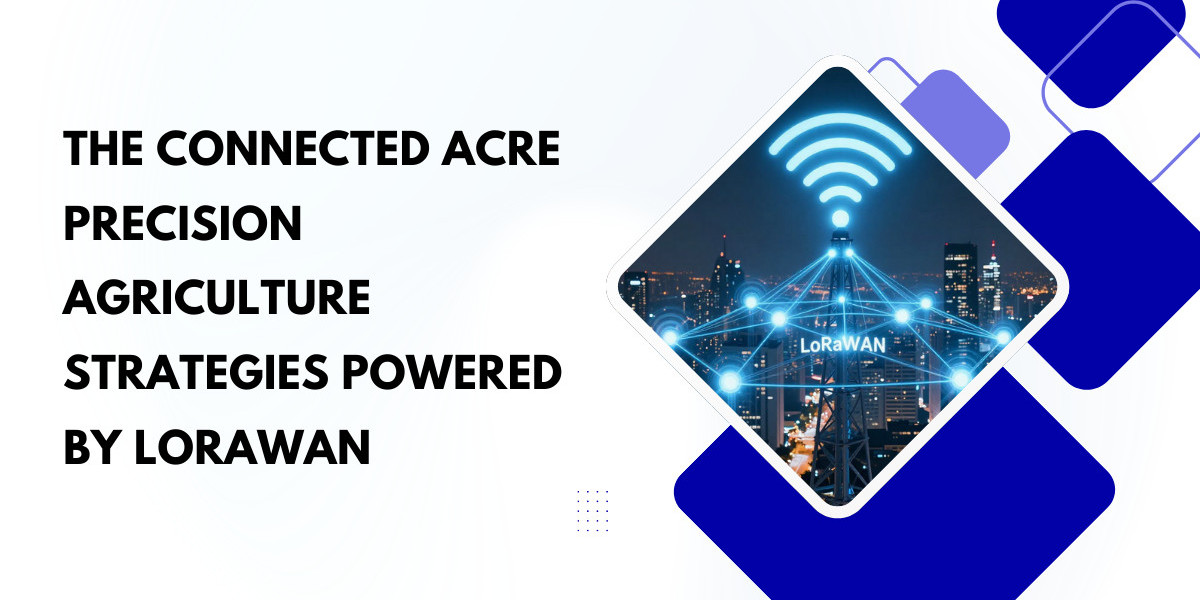

Precision agriculture is changing the way we grow food. As global food demand rises, farmers must produce more with fewer resources. Traditional farming often uses a "one-size-fits-all" approach to water and nutrients. However, modern fields require a high level of granular data to stay productive. This is where a LoRaWAN-Based Solution becomes vital for the modern farm.
LoRaWAN stands for Long Range Wide Area Network. It is a communication protocol designed for the Internet of Things (IoT). In agriculture, this technology connects sensors across miles of land without needing expensive cellular plans or complex wiring. By 2026, the Indian precision agriculture market alone is expected to hit $2 billion. Much of this growth comes from low-power, long-range networks that allow for "The Connected Acre."
Why LoRaWAN Fits Large-Scale Farming
Standard wireless options like Wi-Fi or Bluetooth fail on large farms. Wi-Fi has a short range and consumes high power. Bluetooth is only useful for very close distances. Cellular networks require a SIM card for every sensor, which creates high monthly costs. A LoRaWAN Solution solves these problems through three technical strengths.
1. Superior Range
A single LoRaWAN gateway can receive signals from sensors up to 15 kilometers away in open rural terrain. This range allows a farmer to cover thousands of acres with just one or two base stations. It provides deep penetration through dense crops and foliage that usually block other signals.
2. Extreme Battery Life
LoRaWAN devices use very little energy. Most agricultural sensors only send small packets of data every few hours. Because the devices sleep between transmissions, they can run on a single battery for five to ten years. This removes the need for frequent maintenance in remote fields.
3. Low Cost of Ownership
Because LoRaWAN uses unlicensed radio bands, farmers do not pay for data usage. The hardware is also affordable. Basic sensor nodes often cost less than $10 per unit to manufacture. This makes it possible to deploy hundreds of sensors across a property without breaking the budget.
Technical Components of a LoRaWAN Solution
To build a connected acre, a farmer needs a complete ecosystem of hardware and software. Each part plays a specific role in moving data from the soil to the screen.
1. The Sensor Nodes (End Devices)
These are the "eyes and ears" of the farm. They sit in the soil, on trees, or even on livestock.
Soil Moisture Probes: These measure the volumetric water content.
NPK Sensors: These track Nitrogen, Phosphorus, and Potassium levels.
Weather Stations: These monitor wind speed, rainfall, and humidity.
Leaf Wetness Sensors: These help predict fungal outbreaks.
2. The LoRaWAN Gateway
The gateway acts as a bridge. It collects radio signals from all sensors in the area. It then converts these signals into data that travels over the internet via Ethernet, Wi-Fi, or a single 4G backhaul.
3. The Network and Application Server
The network server manages the security and traffic of the devices. The application server turns raw numbers into visual charts. This is where the farmer sees the "intelligence" of the field.
Precision Irrigation: Saving Water by the Drop
Water scarcity is a major threat to global farming. Studies show that a LoRaWAN-Based Solution for irrigation can improve water use efficiency by up to 34%. Instead of watering on a set timer, farmers use real-time soil data.
Case Study: Smart Irrigation in Maharashtra
In Maharashtra, India, a group of farmers used LoRaWAN soil sensors to manage drip irrigation. Before the tech, they watered based on visual checks. After the installation, they achieved:
30% reduction in total water usage.
20% increase in crop yield.
Lower energy bills because water pumps ran for fewer hours.
By knowing exactly when the soil reaches a "refill point," the system prevents both over-watering and crop stress. This data-driven approach protects the root zone and keeps nutrients from washing away.
Monitoring Soil Health and Nutrients
Soil is not uniform. One part of a field might be rich in nitrogen, while another is depleted. Applying the same amount of fertilizer everywhere is wasteful and harms the environment.
A LoRaWAN Solution allows for "Variable Rate Application." Sensors map the nutrient levels across the field. Farmers can then use this map to apply fertilizer only where it is needed. This reduces chemical runoff into local water sources and saves money on expensive inputs.
Key Stats on Resource Savings
Resource | Traditional Method | LoRaWAN-Based Method | Potential Savings |
Water | Scheduled Timers | Soil-Triggered | 30% to 50% |
Fertilizer | Uniform Spread | Targeted Mapping | 15% to 25% |
Labor | Manual Field Checks | Remote Monitoring | 40% |
Crop Loss | Reactive Treatment | Predictive Alerts | 20% |
Pest and Disease Management
Early detection is the only way to stop a pest outbreak before it ruins a harvest. LoRaWAN sensors monitor the micro-climate under the crop canopy. High humidity and specific temperatures often signal the start of fungal growth.
When the system detects these conditions, it sends an alert to the farmer’s phone. The farmer can then apply a targeted treatment to a small area. This "spot treatment" is much cheaper and safer than spraying an entire 100-acre field.
Livestock Tracking and Health
Large ranches struggle to keep track of every animal. LoRaWAN-based GPS collars allow for real-time tracking of cattle. These devices do more than just show location.
Geofencing: If a cow leaves a safe zone, the farmer gets an alert. This prevents theft and loss.
Health Monitoring: Accelerometers in the collars track movement patterns. A sudden drop in activity can signal illness days before physical symptoms appear.
Grazing Optimization: Data shows which parts of a pasture are overgrazed. This helps the farmer rotate the herd to keep the land healthy.
Overcoming Technical Challenges
While a LoRaWAN-Based Solution is powerful, it requires careful planning.
1. Managing Signal Interference
In some areas, hills or large metal buildings can block radio waves. Engineers must place gateways at high points to ensure a "Line of Sight." Testing the Signal-to-Noise Ratio (SNR) is critical during setup. Research shows that maintaining an SNR above 11.8 dB ensures minimal data loss.
2. Data Security
Farming data is valuable. Modern LoRaWAN networks use AES-128 encryption. This ensures that no one can "listen in" on the farm's data or hijack the irrigation valves. Security happens at two levels: the network level and the application level.
3. Integration with AI
By 2025, over 82% of large farms will use some form of IoT. The next step is connecting LoRaWAN data to Artificial Intelligence. AI can look at years of soil data and weather patterns to tell a farmer the exact day to plant for the best harvest.
The Future of the Connected Acre
The adoption of LPWAN (Low Power Wide Area Network) technology is accelerating. By 2034, the global LoRaWAN market will likely exceed $75 billion. Agriculture remains one of the top three sectors driving this growth.
Future systems will likely combine LoRaWAN with 5G. LoRaWAN will handle the thousands of small sensors, while 5G will handle high-bandwidth tasks like autonomous tractors and drone video feeds. This hybrid approach will create a fully autonomous farm environment.
Conclusion
Implementing a LoRaWAN-Based Solution offers a clear path to sustainable farming. It provides the long-range connectivity needed for vast landscapes. It keeps costs low by using battery-powered devices that last for years. Most importantly, it gives farmers the data they need to make smart decisions.
Precision agriculture is no longer a luxury for the wealthy. It is a necessary tool for food security. By connecting every acre, we can protect our natural resources while feeding a growing world.