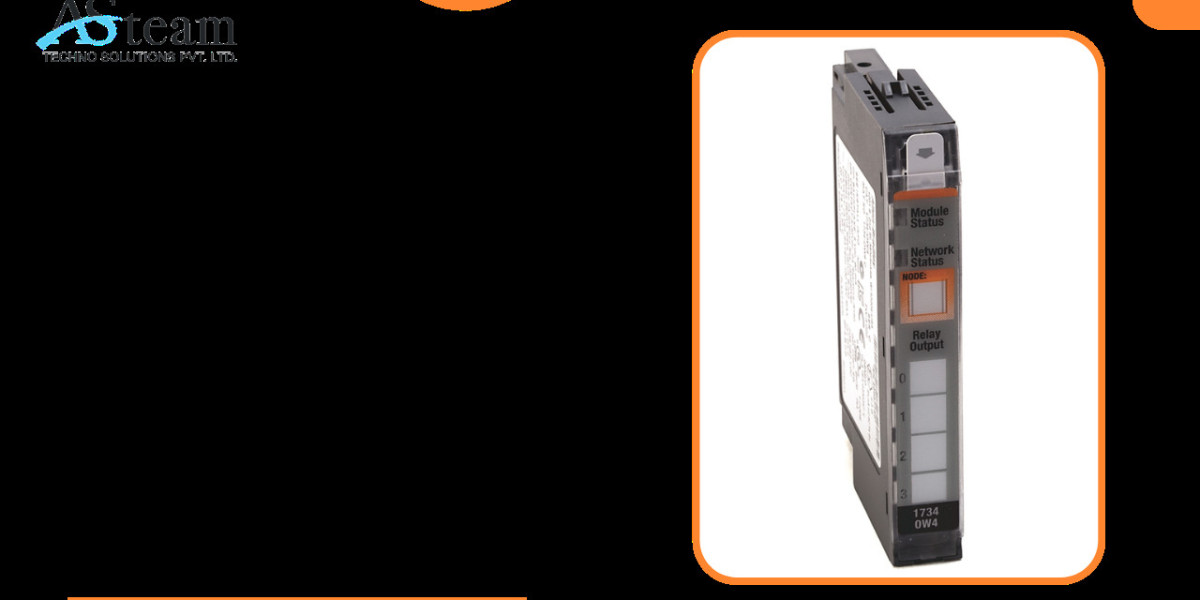

In modern industrial automation systems, reliable communication between devices is the bloodstream of the entire operation. When a module suddenly stops responding or starts generating inconsistent signals, productivity can collapse like a domino corridor in a factory hallway. One commonly discussed issue in industrial control systems is communication failure in the Allen Bradley 1734-OW4 module. Understanding the reasons behind these failures helps maintenance teams reduce downtime, improve system efficiency, and extend equipment life.
The 1734-OW4 module is widely used in POINT I/O systems for digital output applications. While the module is designed for stable performance, communication errors can still occur due to several technical and environmental factors. Identifying the exact cause is the first step toward restoring smooth operation.
Understanding the 1734-OW4 Module
The 1734-OW4 module is a four-point relay output module commonly integrated into industrial automation systems. It communicates with PLCs and controllers through a POINT I/O adapter. Since the module operates as part of a larger network, communication depends on proper wiring, stable voltage, correct configuration, and healthy network conditions.
Even a small issue in one section of the system can trigger communication errors in the 1734-OW4 module. These errors may appear as blinking status LEDs, failed output activation, intermittent responses, or complete loss of communication with the controller.
Incorrect Network Configuration
One of the most common causes of communication errors in the 1734-OW4 module is improper network configuration. Industrial networks rely heavily on precise communication settings. If the module address, node configuration, or adapter settings do not match the PLC configuration, the controller may fail to recognize the module.
Configuration mismatches often occur during:
System upgrades
Module replacement
Firmware updates
Expansion of existing I/O systems
For example, if the slot assignment in the PLC software does not correspond to the actual physical position of the 1734-OW4 module, communication can fail instantly. The controller may display module fault warnings or produce inconsistent outputs.
Carefully verifying the hardware tree and network parameters can eliminate many communication-related issues before they become operational problems.
Loose or Improper Wiring Connections
Industrial environments are filled with vibration, heat, dust, and continuous machine movement. Over time, wiring terminals can loosen and create unstable electrical connections. This instability can interrupt communication between the 1734-OW4 module and the controller.
Improper wiring can include:
Loose terminal screws
Damaged communication cables
Incorrect polarity connections
Broken conductors
Poor grounding
A poorly grounded system behaves like a radio antenna trapped inside an electrical storm. Noise interference begins to corrupt signals, causing the 1734-OW4 module to lose communication intermittently.
Routine inspection of terminal blocks and cable integrity is essential for maintaining reliable module communication.
Power Supply Fluctuations
Stable power is critical for industrial communication systems. Voltage drops, surges, or unstable power supplies can disrupt module operation and generate communication faults in the 1734-OW4 module.
Common power-related causes include:
Overloaded power supplies
Shared power sources with heavy machinery
Incorrect voltage ratings
Sudden power interruptions
When the module does not receive sufficient voltage, it may partially operate while failing to maintain communication with the controller. This creates confusing symptoms where outputs appear inactive even though the system remains powered.
Using a dedicated and properly rated power supply significantly reduces communication instability.
Electromagnetic Interference (EMI)
Electromagnetic interference is another major reason behind communication errors in the 1734-OW4 module. Industrial facilities contain motors, VFDs, contactors, welding machines, and high-voltage cables that generate electrical noise.
This interference can corrupt communication signals traveling between devices. The result may include:
Random communication drops
Delayed output response
Controller timeout errors
Unstable module detection
Improper cable routing increases the risk of EMI exposure. Communication cables placed near high-power electrical lines act like unwilling passengers traveling through a thunderstorm of electrical noise.
To reduce EMI problems:
Use shielded communication cables
Maintain proper cable separation
Ensure effective grounding
Install noise suppression devices where necessary
These practices help maintain stable communication within the 1734-OW4 module network.
Faulty POINT I/O Adapter
The 1734-OW4 module depends heavily on the POINT I/O adapter for communication with the controller. If the adapter develops faults, every connected module can experience communication problems.
A defective adapter may cause:
Complete loss of communication
Module recognition failures
Intermittent network disconnects
System-wide I/O faults
In many cases, technicians initially suspect the 1734-OW4 module itself, while the actual issue originates from the communication adapter.
Checking adapter diagnostics, firmware compatibility, and network status indicators can help isolate the root cause quickly.
Firmware Compatibility Issues
Firmware mismatches often create hidden communication problems that are difficult to diagnose. If the controller firmware version is incompatible with the 1734-OW4 module or POINT I/O adapter firmware, communication may become unstable.
Firmware issues commonly appear after:
PLC software upgrades
System migration projects
Replacing old modules with newer revisions
Symptoms may include delayed communication, module faults, or complete communication loss.
Maintaining firmware compatibility across all automation components is essential for reliable system performance. Always verify manufacturer compatibility guidelines before performing upgrades.
Environmental Conditions
Industrial automation equipment operates in demanding environments. Excessive heat, moisture, dust, and vibration can affect communication stability in the 1734-OW4 module.
High temperatures may damage internal circuitry, while moisture can create corrosion on connectors and terminals. Dust accumulation can also interfere with electrical contacts over time.
Environmental stress can gradually transform a stable communication system into an unpredictable maze of intermittent faults.
To protect the module:
Install equipment in properly ventilated panels
Maintain recommended temperature ranges
Use sealed enclosures where necessary
Perform regular preventive maintenance
A clean and controlled environment greatly improves communication reliability.
Module Hardware Failure
Like any industrial device, the 1734-OW4 module itself can eventually fail due to aging or internal component damage. Hardware failures may occur because of:
Electrical overloads
Short circuits
Excessive heat exposure
Mechanical stress
Long operational life
When internal circuitry becomes damaged, communication errors may become persistent despite correct wiring and configuration.
Typical signs of module failure include:
Continuous fault LEDs
Burn marks or unusual odor
No response from outputs
Repeated communication alarms
In such cases, replacing the 1734-OW4 module is usually the most effective solution.
Preventing Communication Errors
Preventive maintenance remains the strongest defense against communication problems in the 1734-OW4 module. A proactive maintenance strategy helps identify small issues before they evolve into expensive system failures.
Best practices include:
Regular inspection of wiring and terminals
Stable power supply management
Firmware compatibility checks
Proper grounding techniques
Environmental monitoring
Scheduled network diagnostics
Industrial automation systems behave much like orchestras. When every component stays synchronized, operations flow smoothly. But if one instrument falls out of rhythm, the entire performance can become chaotic.
Conclusion
Communication errors in the 1734-OW4 module can arise from multiple sources, including wiring problems, network configuration issues, power instability, EMI, firmware incompatibility, environmental stress, or hardware failure. Since industrial automation systems depend on continuous and accurate communication, even minor faults can lead to operational disruption and production losses.
Understanding these causes allows technicians and engineers to troubleshoot problems more efficiently and maintain system reliability. With proper installation, preventive maintenance, and careful monitoring, the 1734-OW4 module can continue operating with stable and dependable communication in demanding industrial environments.
FAQs
1. What are the common communication errors in the 1734-OW4 module?
Common communication errors include intermittent network disconnections, module recognition failures, blinking fault LEDs, delayed output response, and complete loss of communication with the PLC controller.
2. Can loose wiring cause communication issues in the 1734-OW4 module?
Yes, loose or damaged wiring is one of the leading causes of communication problems. Poor terminal connections, broken cables, or incorrect grounding can interrupt signal transmission and create unstable communication.
3. How does electromagnetic interference affect the 1734-OW4 module?
Electromagnetic interference (EMI) generated by motors, VFDs, or high-voltage equipment can corrupt communication signals. This may lead to random communication drops, timeout errors, or inconsistent module performance.
4. Does firmware mismatch create communication problems in the 1734-OW4 module?
Yes, incompatible firmware versions between the PLC, POINT I/O adapter, and the 1734-OW4 module can result in communication instability, module faults, or configuration errors.
5. How can communication errors in the 1734-OW4 module be prevented?
Communication errors can be reduced through proper wiring practices, stable power supply management, regular maintenance, firmware updates, correct grounding, and protection against environmental factors such as heat, moisture, and dust.
Reach Us
Asteam Techno Solutions Pvt. Ltd. is AVEVA (Formerly Wonderware) Registered System Integrator providing sale/service/support and executing the HMI/SCADA, Historian/MES Solutions to End-user & OEM/System Integrator community for their diverse needs.
Leading single-source supplier & solution provider for industrial automation hardware and software solutions needed.
Preferred wholesale supplier, stockiest & exporter of Programmable Logic Controller (PLC), Drive (VFD), HMI, Panel PC, SCADA, Profibus Connector, Cable, and many more automation products.
We serve OEM, Pharmaceuticals, Chemicals, Petrochemicals, oil & gas, Panel manufacturers along with our process equipment. Also, we deliver services to Food processing OEM, electrical industries & mechanical industries with our special purpose process components.